Last Updated: August 25, 2026 | Written by Draw My Twin Flame Editorial Team | 9 Min Read

How Does a Twin Flame Work? The Concept Explained
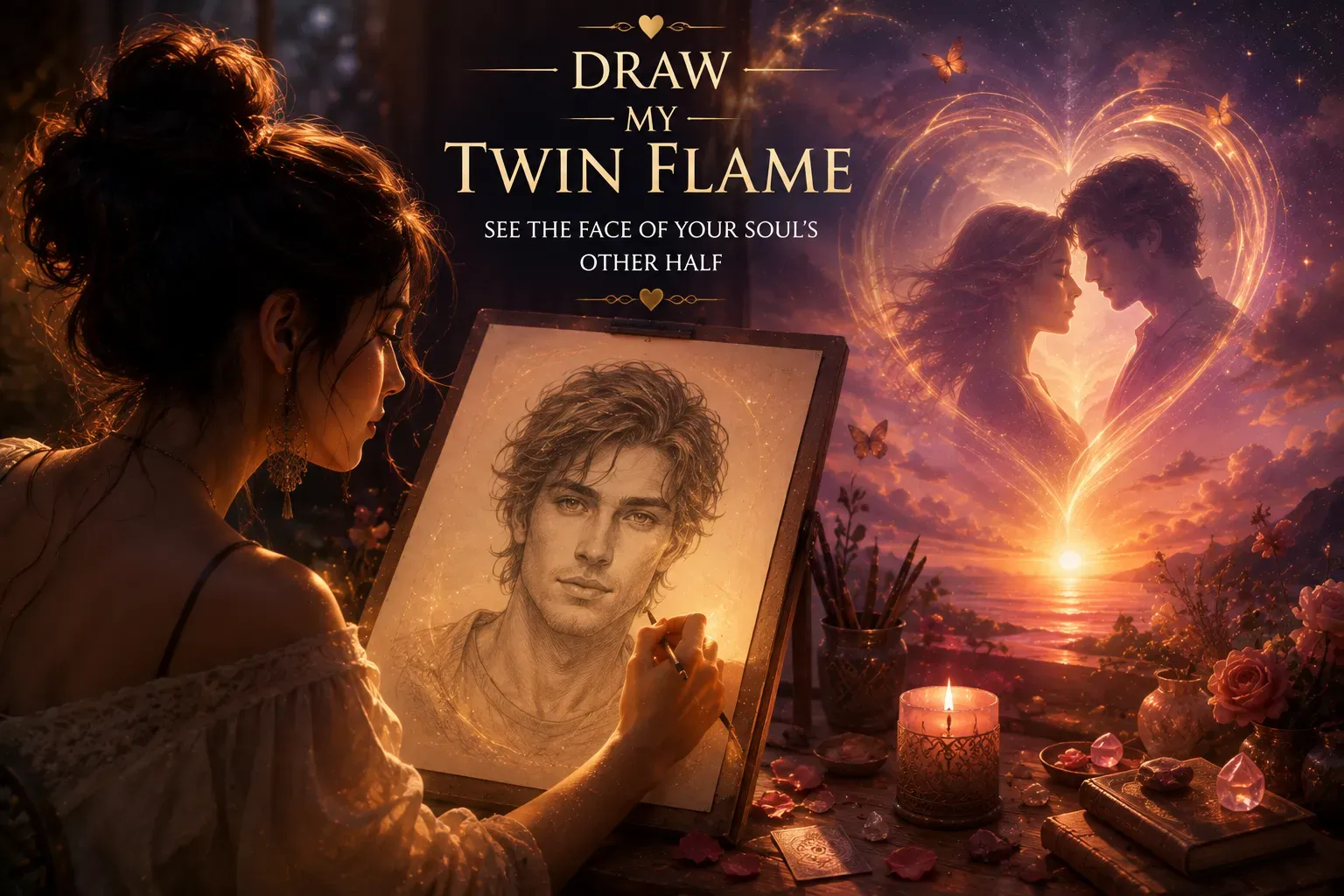
Draw My Twin Flame hero artwork showing a hand-drawn twin flame portrait being sketched

So how does a twin flame work, according to the people who write and teach about the concept? In modern spirituality, a twin flame is commonly described as one soul that split into two bodies, with the two halves believed to reconnect at some point in this lifetime to mirror each other's growth.

That is a belief, not a scientific claim, and this guide treats it that way throughout. Below, we walk through where the idea comes from, the stages many spiritual writers describe, how it differs from the older idea of a "soulmate," and the honest limits of what any of this can tell you.

If you searched "how does a twin flame work" or "how do twin flames work," this page lays out the concept in plain language, with every claim clearly framed as belief rather than fact.

Explore a Twin Flame Portrait Reading

What Is a Twin Flame, According to Modern Spirituality?

According to twin flame spirituality, a twin flame is commonly described as one soul that divided into two people before incarnating, so that the pair is believed to share an unusually intense, mirror-like bond. This is a New Age belief popularized largely through spiritual blogs, YouTube channels, and psychic-style services since the 1970s and 1980s. It is not a term used in psychology, biology, or any established scientific field, and no independent evidence supports it as a literal, measurable phenomenon.

Where Does the Twin Flame Concept Come From?

The modern twin flame idea is generally traced to New Age spiritual writing from the late 20th century, though many teachers who use the term also borrow language from much older philosophical traditions to give it a sense of ancient lineage.

Is the Twin Flame Idea the Same as Plato's "Other Half"?

Not exactly, though the two are frequently conflated. Plato's Symposium, an ancient Greek philosophical text, describes an origin myth in which humans were originally fused, dual-bodied beings later split in two by the gods, leaving each half to search for its other side. Many modern twin flame writers reference this myth as an early precursor, but the specific term "twin flame," along with its stages and terminology, is a distinctly modern spiritual framework, not a direct continuation of Plato's text.

Who Popularized the Term "Twin Flame"?

There is no single, universally agreed-upon originator. The concept spread primarily through independent spiritual authors, workshops, and later social media and YouTube content, rather than through one recognized book or teacher the way some other New Age concepts are traced.

Key takeaway: Treat the twin flame concept as a modern spiritual belief with loose roots in older philosophy, not as a documented historical or scientific framework with one clear origin.

Is a twin flame the same thing as a soulmate? Not according to most twin flame writers. A soulmate is generally described as a deeply compatible, comfortable connection, while a twin flame is described as a more intense, challenging mirror-soul connection. Both are subjective spiritual beliefs, not scientifically distinguishable categories.

How Is a Twin Flame Different From a Soulmate?

Within twin flame spirituality, a soulmate and a twin flame are usually described as two different kinds of connection, even though both terms get used loosely in everyday conversation.

AspectSoulmate (commonly described)Twin Flame (commonly described)
General feelComfortable, easy, supportiveIntense, challenging, transformative
Number of connectionsBelieved to have multiple over a lifetimeBelieved to have only one, per most writers
Growth patternSteady companionshipSaid to trigger rapid personal growth or upheaval
OutcomeOften lasting partnershipSome writers describe separation as a common stage

These distinctions come from popular twin flame spirituality writing and are not standardized, scientifically defined, or consistent across every author who uses the terms.

How Does a Twin Flame Connection Reportedly Work?

Many spiritual writers describe a twin flame connection unfolding through a loose sequence of stages, though there is no single official version, and different teachers describe these phases in different orders or with different names.

What Are the Commonly Described Stages?

  1. Recognition: Some who believe in the concept describe an initial meeting marked by an unusually strong, instant sense of familiarity or deja vu with the other person.
  2. Testing: Many twin flame writers describe an early phase where old insecurities, fears, or unresolved patterns are said to surface, sometimes attributed to the intensity of the bond itself.
  3. The "runner-chaser" dynamic: Some writers describe one person pulling away emotionally (the "runner") while the other pursues closeness (the "chaser"). This pattern is subjective and, notably, closely resembles ordinary anxious-avoidant relationship dynamics described in mainstream relationship literature.
  4. Harmony or separation: Depending on the writer, the relationship is described as eventually settling into a stable, balanced partnership ("union"), or alternatively ending in separation that some frame as still spiritually meaningful.

Important note: These stages are presented across twin flame spirituality content as a loose narrative framework, not a diagnostic or predictive model. They should never be used to justify staying in an unhealthy or unsafe relationship, and they are not a substitute for professional relationship or psychological counseling.

A Loosely Described, Non-Linear Journey

Does the runner-chaser dynamic actually happen? The push-pull pattern some call 'runner-chaser' is a subjective label used within twin flame spirituality. It closely overlaps with ordinary attachment patterns already described in mainstream relationship psychology, so it is not evidence of anything uniquely 'twin flame' about a relationship.

Is There Scientific Evidence for Twin Flames?

No. There is no peer-reviewed scientific evidence that "twin flames" exist as a literal, measurable phenomenon, and no established field of psychology, biology, or medicine recognizes the term as a factual category of relationship.

Why Do the Feelings Still Feel Real?

Strong attraction, deja vu, and a sense of instant familiarity are genuine human experiences studied in relationship psychology, but researchers explain them through ordinary factors: shared values, timing, attachment style, and simple compatibility, rather than a spiritual "one soul, two bodies" mechanism. Feeling something intensely does not, on its own, confirm any specific spiritual explanation for why.

So Why Do So Many People Believe in It?

Proponents of the idea suggest that the twin flame framework simply gives people a meaningful vocabulary for an intense connection that otherwise feels hard to describe. That is a legitimate reason people find the concept valuable for reflection, even though it remains a belief rather than a verified fact.

Key takeaway: Enjoy the twin flame concept as a spiritual and reflective lens if it resonates with you, but do not treat it as an established fact when making real relationship decisions.

How Do People Try to Explore What Their Twin Flame Might Look Like?

A Reflective Exercise, Not a Prediction

Because the twin flame concept centers on a specific other person, some people who are curious about the idea look for reflective ways to imagine what that connection might look like, rather than treating it as a literal search.

One example some people explore is a personalized twin flame portrait reading, such as the one described on this site. According to the vendor, a service like Draw My Twin Flame takes details you submit (your birth date, relationship status, and short questionnaire answers) and produces a hand-drawn portrait along with a written personality description, typically delivered digitally within 12–48 hours. We treat this kind of service the same way we treat the twin flame concept generally: as an entertainment and self-reflection product, not a scientifically verified prediction. If you want the full breakdown of how that specific process works, see our guide on what a twin flame psychic drawing is, or read our complete Draw My Twin Flame review.

See Current Pricing

Can a portrait reading actually show my real twin flame's face? No independent way exists to verify that. According to the vendor, an artist hand-draws a portrait based on the details you submit, and it should be treated as an artistic, reflective interpretation rather than a literal, confirmed likeness of a real person.

Who Tends to Find the Twin Flame Concept Meaningful?

The twin flame idea tends to resonate most with people already comfortable exploring spirituality as a lens for self-reflection, rather than people looking for a scientifically backed relationship framework.

  • People already into astrology or tarot: The twin flame concept overlaps with other New Age practices many spiritually curious people already enjoy.
  • People processing an intense past connection: Some use the framework as a way to make sense of a relationship that felt unusually significant, without claiming it as objective fact.
  • People who enjoy journaling and self-reflection: The stages and language of the concept can serve as prompts for thinking about personal growth and relationship patterns.

If none of that describes you, or if the framework feels like it is being used to justify staying in a difficult relationship, that is an important signal to step back and consider talking with a licensed therapist or counselor instead.

What Should You Keep in Mind Before Exploring the Twin Flame Concept?

The twin flame concept can be a fun, low-stakes way to reflect on relationships, but it works best when you keep a few honest boundaries in mind.

  • It is entertainment and self-reflection, not fact: No twin flame claim, stage, or reading should be treated as scientifically verified or predictive of your real life.
  • It is not a substitute for professional help: If you are navigating real relationship distress, a breakup, or mental health concerns, a licensed therapist or counselor is the appropriate resource, not a spiritual framework or reading.
  • Don't let it excuse unhealthy patterns: The "testing" and "runner-chaser" language should never be used to rationalize staying in a relationship that feels unsafe or unhealthy.

Disclaimer: This page is provided for entertainment and self-reflection purposes only. The twin flame concept is a modern spiritual belief, not a scientifically established phenomenon, and nothing on this page is a substitute for professional relationship or psychological counseling.

Reflect Thoughtfully, Not Literally

Frequently Asked Questions About How Twin Flames Work

In twin flame spirituality, a twin flame is commonly described as one soul that split into two people before this lifetime, then reconnects to mirror each other's growth. This is a belief within modern New Age spirituality, not a scientifically established phenomenon, so it's best understood as a reflective framework rather than a factual process.

No, most twin flame writers treat them as different things. A soulmate is usually described as a comfortable, supportive connection, while a twin flame is framed as a more intense, challenging "mirror soul" bond. Both terms come from spiritual belief systems, and neither is a scientifically distinguishable category.

Many spiritual writers describe a loose sequence: recognition, a testing or challenging phase, a push-pull "runner-chaser" dynamic some describe, and eventual harmony or separation. There's no single official version of these stages. Treat them as a narrative framework, not a diagnostic model.

No independent, peer-reviewed evidence supports twin flames as a literal, measurable phenomenon. The intense feelings people describe, like instant familiarity or deja vu, are recognized in relationship psychology, but psychologists explain them through ordinary factors rather than a spiritual "one soul, two bodies" mechanism.

The modern twin flame concept is generally traced to New Age spiritual writing, though many teachers also point to older philosophical ideas, like the origin myth in Plato's Symposium, to give it a sense of ancient lineage. There's no single, universally agreed-upon originator of the specific term.

More Twin Flame Drawing Guides

About This Guide

Author: Draw My Twin Flame Editorial Team

Written by the Draw My Twin Flame Editorial Team, based on research into how the twin flame concept is described across popular spiritual writing. This page is for entertainment and self-reflection purposes only and contains affiliate links. If you order through our links, we may receive compensation at no additional cost to you. Last updated August 25, 2026.